
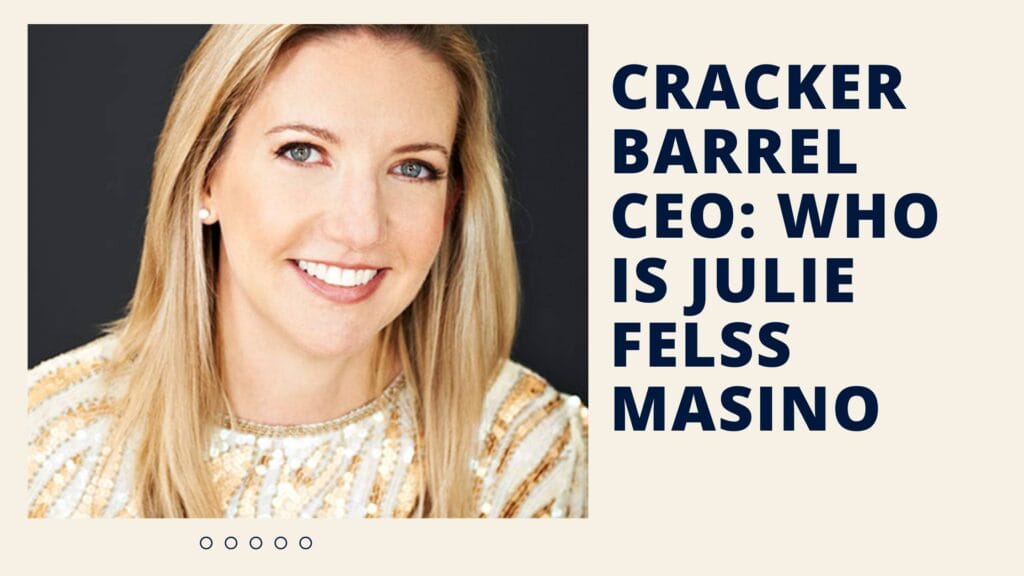
Cracker Barrel CEO: Who Is Julie Felss Masino, Her Full Background, Strategy & the Complete Leadership History
Julie Felss Masino is the current President and Chief Executive Officer of Cracker Barrel Old Country Store, a position she assumed on November 1, 2023, making her the 4th CEO in the company's 56-year history. She succeeded Sandra B. Cochran, who held the role for 12 years from September 2011 to October 2023 — the longest tenure of any CEO in CBOCS, Inc.'s history — and the longest of any chief executive at a publicly traded restaurant chain during the same period.
Masino was recruited for her track record as a brand innovator at Taco Bell International, where she oversaw the expansion of the division to more than 1,000 restaurants across 32 countries and led the $11 billion U.S. Taco Bell business through 8 consecutive quarters of positive comparable sales growth. The CBOCS, Inc. board selected her to execute a strategic transformation of a heritage brand facing structural revenue stagnation, declining dinner traffic, and a contracting core customer demographic. Her tenure has been defined by a $700 million "All the More" transformation campaign, a logo rebrand controversy that cost $143 million in market capitalization and was reversed within 9 days, a shareholder battle in which she survived a push for her removal, and a subsequent Q2 FY2026 earnings result that exceeded analyst expectations despite continued revenue decline.
This article provides the complete biography, career timeline, strategic initiatives, and performance record of Julie Felss Masino, the history of every Cracker Barrel CEO from founder Dan Evins through the present day, the 5 pillars of Masino's transformation plan, the full Sardar Biglari activist investor conflict, and all key financial outcomes produced under her leadership as of March 2026.
Who Is Julie Felss Masino, the Current Cracker Barrel CEO?
Julie Felss Masino, age 52 at the time of her appointment, is a consumer brand executive with over 30 years of experience across restaurant, retail, and consumer goods — confirmed by CBOCS, Inc.'s official investor relations documentation as the 4th person to hold the title of President and Chief Executive Officer in the company's history.

Julie Felss Masino
President & CEO
CBOCS, Inc.
Executive Profile
What Is Julie Felss Masino's Career History Before Cracker Barrel?
Julie Felss Masino built her executive career across 7 companies over 30 years, beginning in corporate retail at Godiva Chocolatier, Coach, J. Crew, and Macy's before rising to VP-level positions at Starbucks Corporation, then serving as CEO of Sprinkles Cupcakes, President and SVP/GM of Fisher-Price at Mattel, and finally President of North America and then International at Taco Bell — the role from which CBOCS, Inc. recruited her.
Early Career — 1990s
Masino begins her professional career in corporate positions at iconic American retail and luxury brands: Godiva Chocolatier, Coach, J. Crew, and Macy's. These foundational roles establish her fluency in premium consumer brands, retail merchandising, and customer experience design.
2002–2014 — Starbucks Corporation (NASDAQ: SBUX)
Masino spends 12 years at Starbucks in multiple Vice President roles including VP of Strategy for the Americas and EMEA, VP of Global Beverage, VP of Global Merchandise and Packaged Food, and Chief Marketing Officer of Starbucks' China business. Her 12 years at Starbucks constitute the longest single-company tenure in her pre-CBOCS career and establish her expertise in scaling premium consumer brands across international markets.
2014–2017 — Sprinkles Cupcakes
Masino serves as President and then Chief Executive Officer of Sprinkles Cupcakes, the Beverly Hills-based premium cupcake chain founded by Candace Nelson. She leads the brand through a growth phase that included expansion into new markets and the introduction of the Sprinkles ATM concept — a 24-hour automated cupcake dispensing machine that received national media coverage.
April 2017–January 2018 — Mattel, Inc. (NASDAQ: MAT)
Masino serves as President, SVP and General Manager of Fisher-Price — Mattel's flagship infant and preschool toy brand. Her tenure at Mattel is brief, lasting less than 12 months, before she moves to Taco Bell.
January 2018–December 2019 — Taco Bell North America
Masino serves as President, North America of Taco Bell, a subsidiary of Yum! Brands, Inc. (NYSE: YUM). She leads the $11 billion U.S. Taco Bell business through 8 consecutive quarters of positive comparable sales growth — a performance record that CBOCS, Inc.'s board cites as one of the primary reasons for her selection as Cracker Barrel CEO. Her team launches multiple culinary, technology, and business model innovations during this period.
January 2020–June 2023 — Taco Bell International
Masino is promoted to President, International of Taco Bell, overseeing the expansion of the division from approximately 600 to more than 1,000 restaurants across 32 countries. During this 3.5-year period, Taco Bell opens over 800 new units in the U.S. and globally under her leadership. Her international expansion track record at Taco Bell is the specific experience that distinguishes her from internal CBOCS, Inc. candidates considered during the CEO succession planning process.
July 2023 — Cracker Barrel CEO Named
CBOCS, Inc. announces Masino as its next President and CEO. She assumes the CEO-elect role on August 7, 2023, works through a transition period with outgoing CEO Sandra B. Cochran, and officially becomes President and CEO and a CBOCS, Inc. Board member on November 1, 2023.
Why Did the CBOCS, Inc. Board Select Julie Felss Masino?
CBOCS, Inc. Board Chairman William McCarten stated that Masino was selected for 3 specific qualities: her track record as an innovator, her strategic thinking for growth, and her experience modernizing heritage restaurant brands across multiple customer demographics — qualities the board determined were essential to reversing Cracker Barrel's declining dinner traffic and stagnant revenue trajectory.
The appointment was the culmination of a multi-year CEO succession-planning process that CBOCS, Inc. launched while Sandra Cochran was still in the role. Board Chairman McCarten confirmed publicly: "We believe Julie's track record as an innovator and a leader, together with her strategic thinking and passion for growth, will ensure that Cracker Barrel remains a place where people feel welcomed and cared for like family as we extend our hospitality to an even broader array of guests." The specific reference to "an even broader array of guests" signaled the board's intent to expand the brand's customer demographic beyond its historically dominant over-65 core segment.
What Is Julie Felss Masino's Transformation Strategy for Cracker Barrel?
Masino's transformation strategy — announced publicly on May 16, 2024 under the name "All the More" — is a $700 million, 3-year plan organized around 5 pillars: refining the brand identity, enhancing the food and beverage menu, remodeling restaurant and retail environments, improving the employee and guest experience, and strengthening digital and loyalty capabilities.
Brand Identity Refinement
Evolving Cracker Barrel's brand identity across all touchpoints to attract a younger demographic while preserving heritage. This pillar produced the August 2026 logo rebrand — the most controversial single decision of Masino's tenure — which was reversed 9 days after launch following $143 million in market capitalization losses and sustained public opposition.
Menu Enhancement
Updating the food and beverage menu to expand dinner occasion appeal and introduce broader, lighter options alongside comfort-food staples. New items introduced under this pillar include Hashbrown Casserole Shepherd's Pie, Barrel Bites appetizers, an expanded breakfast menu, and seasonal limited-time offerings including the 2026 Campfire Meals return.
Store Remodeling
Transitioning restaurant and retail interiors from the dark, antique-filled country store aesthetic to a "modern farmhouse" design with lighter walls, contemporary seating, and reduced antique density. 30 of 660 locations received full remodels by mid-2025. Early data shows higher sales and improved traffic at remodeled locations relative to unremodeled stores.
Employee & Guest Experience
Improving front-of-house service consistency, kitchen execution quality, and the overall dining experience. This pillar produced the October 2026 all-manager and kitchen staff retraining on core recipes following a kitchen simplification effort that Masino acknowledged "made consistent execution more challenging." Google star ratings reached their highest level since 2020 following the retraining initiative.
Digital & Loyalty
Building the Cracker Barrel Rewards loyalty program and digital ordering infrastructure. By Q1 FY2026, the Rewards program had surpassed 10 million members, adding 1 million members in the single quarter, with members accounting for 40% of tracked sales. The Front Porch Feedback program — a loyalty-member feedback mechanism launched September 2026 — now guides menu and operational decisions.
The "All the More" strategy produced measurable positive results in 3 specific areas before the August 2026 logo controversy: 5 consecutive quarters of dinner traffic improvement leading into summer 2026, strong early performance data from the 30 remodeled store locations, and a Rewards program that grew from 0 to 10 million members in under 2 years. The logo controversy's impact on brand trust interrupted what had been a trajectory of incremental progress on these metrics.
What Was the Cracker Barrel Logo Controversy Under Julie Felss Masino?
The August 2026 Cracker Barrel logo controversy began when Masino's leadership team launched a new text-only wordmark on August 18, 2026, removing the 48-year-old illustrated Old Timer figure and "Old Country Store" tagline — producing a 12% stock decline in 8 trading sessions, a $143 million market capitalization loss, and a public reversal on August 26, 2026, after President Donald Trump posted on Truth Social urging the company to return to the original logo.
Masino acknowledged the misstep directly in the Q4 FY2026 earnings call on September 17, 2026, stating that the company "underestimated the emotional connection customers have with our traditional branding." She pledged to "lean into Uncle Herschel and the nostalgia around the brand" — a public commitment to reversing the brand modernization direction that had formed the first pillar of the "All the More" strategy. This acknowledgment represented a significant public repositioning from her original communication of the transformation plan, which had framed brand evolution as a core strategic priority. The full details of the controversy and its market impact are covered in the Cracker Barrel logo controversy analysis.
What Were the Consequences of the Logo Controversy for Masino's Leadership?
The logo controversy produced 4 direct leadership consequences for Masino: a Q4 FY2026 traffic decline of 8% attributed to the logo episode, a full shareholder meeting battle in which activist investor Sardar Biglari sought her removal, a November 20, 2026 shareholder vote that retained her in the CEO role, and the resignation of board member Gilbert Davila following shareholder rejection of his reelection.
The aftermath required 3 corrective operational interventions in Q1 FY2026: the reversal of the kitchen simplification program that had degraded food consistency, a comprehensive retraining of all kitchen production staff and grill cooks on core recipes, and the promotion of Doug Hisel to SVP of Store Operations to streamline the management structure and accelerate execution improvements. These corrections produced measurable results — food taste, service, value, and experience metrics all improved between 3% and 4% year-over-year in October 2026, with larger improvements in November.
What Is the Sardar Biglari Activist Investor Conflict at Cracker Barrel?
Sardar Biglari — chairman and CEO of Biglari Holdings Inc. (NYSE: BH) and owner of Steak 'n Shake — is a long-term Cracker Barrel shareholder who has engaged in an ongoing activist campaign against CBOCS, Inc. management spanning two CEO tenures, including 4 documented warnings to Masino's board about the transformation strategy before the logo controversy and a direct push for Masino's removal in the November 2026 proxy vote.
Biglari's engagement with CBOCS, Inc. predates Masino's tenure. During Sandra Cochran's 12-year leadership, Biglari mounted multiple proxy fights attempting to gain board control, pushed for a forced sale of the company, and consistently criticized the capital allocation decisions made under Cochran's direction. Cochran's board rebuffed each attempt, and the two parties ultimately reached a truce in 2022. When Masino assumed the CEO role in November 2023 and announced the "All the More" transformation plan in May 2024, Biglari immediately re-engaged.
What Did Biglari Warn About the Transformation Strategy?
Between May 2024 and August 2026, Biglari issued 4 documented warnings to CBOCS, Inc. management and shareholders through SEC filings, arguing that the transformation strategy was "obvious folly," that the board was demonstrating "dysfunction and mismanagement," and that remodeling stores would not solve Cracker Barrel's fundamental problem of declining guest traffic.
In a 7-page shareholder letter filed with the Securities and Exchange Commission, Biglari laid out a stark financial comparison: in 2011, Cracker Barrel reported $167 million in operating income on $2.4 billion in revenue. By 2023, after $1.4 billion in cumulative capital expenditures, operating income had fallen to $121 million even as revenues climbed past $3.4 billion. He argued directly: "the problem lies not in the seating but in getting more people to sit in it." He further warned that "We do not believe changing the furniture and altering the décor are going to change the Company's trajectory or solve the Company's underlying problem of declining traffic."
⚡ Proxy Fight Outcome — November 2026
At the November 20, 2026 annual shareholder meeting, Cracker Barrel's 10 board-recommended nominees — including CEO Julie Felss Masino — were elected, defeating Biglari's push for management changes. However, board member Gilbert Davila, who had overseen CBOCS, Inc.'s advertising and brand communications, was rejected by shareholders in a preliminary vote, leading to his resignation from the board on the same day. Two influential shareholder advisory firms — Institutional Shareholder Services (ISS) and Glass Lewis — had recommended against Davila's reelection ahead of the vote, citing the logo controversy as a governance failure in the advertising oversight role.
What Are the Financial Results Under Julie Felss Masino's Leadership?
The financial results of Masino's tenure through Q2 FY2026 (ending January 31, 2026) show mixed performance: 5 consecutive quarters of dinner traffic improvement before August 2026 were offset by a 10.1% traffic decline in Q2 FY2026, revenue declining 7.9% year-over-year in Q2 to $874.8 million, and full-year FY2026 guidance of $3.24–$3.27 billion representing a 6–7% projected revenue contraction from FY2025.
The following table tracks the 6 most significant financial metrics from Masino's tenure across 3 key reporting periods.
| Metric | Pre-Masino Baseline (FY2023) | FY2025 | Q2 FY2026 (Latest) |
|---|---|---|---|
| Annual Revenue | $3.47B | $3.48B (+0.37%) | $874.8M (−7.9% YoY) |
| Net Income | $99M | $46.38M (−53%) | Loss reported in Q1 FY2026 |
| Restaurant Traffic | Baseline | 5 consecutive quarters of dinner traffic improvement | −10.1% YoY (Q2 FY2026) |
| Stock Price | ~$130 (Jan 2024) | ~$55 (pre-logo, Aug 2026) | ~$27 (March 2026) |
| Rewards Members | N/A (program not yet launched) | ~9M members | 10M+ members; 40% of tracked sales |
| FY2026 Revenue Guidance | N/A | N/A | $3.24–$3.27B (−6–7% vs FY2025) |
"We are not leading in any area. We will change that."
— Julie Felss Masino, President & CEO, CBOCS, Inc., at her first public investor presentation, May 16, 2024What Is the Complete History of Cracker Barrel CEOs?
Cracker Barrel has had 4 CEOs across its 56-year history: Dan Evins, the founder who led the company from its 1969 founding until 2001; Michael A. Woodhouse, who guided the post-Evins transition from 2001 to 2011; Sandra B. Cochran, who led the chain through its peak valuation and pandemic recovery from 2011 to 2023; and Julie Felss Masino, the current CEO who assumed the role in November 2023.
Dan Evins — Founder & CEO
1969 – 2001Dan Evins, a former Shell Oil representative from Lebanon, Tennessee, founded Cracker Barrel Old Country Store on September 19, 1969, borrowing $40,000 to build the first location that combined a restaurant, gas station, and general store. He served as CEO through the chain's growth from a single location to over 500 restaurants across the American South. His leadership ended in significant controversy when he instituted an anti-gay hiring policy in 1991 that fired at least 11 employees and sparked nationwide protests — a decision that drew sustained criticism from civil rights organizations and shareholders for over a decade. Evins stepped down as CEO in 2001 and resigned as chairman in 2004 under continued shareholder pressure over the discriminatory policies instituted during his tenure.
Michael A. Woodhouse — CEO
2001 – 2011Michael Woodhouse joined Cracker Barrel in 1995 as Senior Vice President and Chief Financial Officer before rising to the CEO position in 2001. His decade-long tenure focused on stabilizing the company following the controversies of the Evins era, managing relationships with activist investor Sardar Biglari (who began acquiring CBOCS, Inc. shares and pushing for board control during Woodhouse's tenure), and preparing the company for the leadership transition to Sandra Cochran. Woodhouse transitioned to Executive Chairman when Cochran was named CEO in September 2011, facilitating the same structured transition process that Cochran would later replicate with Masino.
Sandra B. "Sandy" Cochran — CEO
2011 – 2023Sandra Cochran holds the distinction of being the longest-serving CEO of any publicly traded restaurant chain during her 12-year tenure and was the second woman in Tennessee history to serve as CEO of a publicly traded company. She joined Cracker Barrel in April 2009 as Executive VP and Chief Financial Officer, was promoted to President and COO in November 2010, and became CEO in September 2011. Before Cracker Barrel, Cochran served as CEO of Books-A-Million for 5 years and as a captain in the United States Army's Ninth Infantry Division. During her 12-year tenure, systemwide restaurant sales grew from $1.93 billion to $2.62 billion — a 36% increase — and average unit volumes reached $3.9 million, the highest in the family dining segment. She successfully defended the company against Sardar Biglari's multiple proxy fights and forced sale attempts. Her tenure also included a $140 million investment in Punch Bowl Social — a game-and-grub entertainment concept — that failed during the Covid-19 pandemic, representing the costliest strategic miscalculation of her otherwise strong record. Cochran retired as Executive Chair on February 22, 2024.
Julie Felss Masino — President & CEO
November 2023 – PresentJulie Felss Masino became CBOCS, Inc.'s 4th CEO and its second female chief executive on November 1, 2023. She was recruited for her innovation track record at Taco Bell International and Starbucks to execute a strategic transformation of a heritage brand facing structural challenges. Her 28-month tenure through March 2026 has been the most publicly turbulent in the company's post-Evins history, combining genuine program successes (10 million Rewards members, Campfire Meals return, 5 consecutive dinner traffic improvement quarters) with the single most damaging operational decision in the company's modern history (the August 2026 logo rebrand and its rapid reversal). She survived the November 2026 shareholder removal attempt and continues to lead the company's recovery effort as of March 2026.
How Does Julie Felss Masino's Leadership Style Compare to Sandra Cochran's?
Julie Felss Masino's leadership style is externally focused, brand-forward, and digitally oriented — contrasting with Sandra Cochran's internally focused, operationally disciplined, and publicity-averse approach that Restaurant Business described as a "head-down" style that avoided industry conferences and kept attention on financial execution rather than brand modernization.
The contrast between the 2 CEOs reflects the different strategic mandates they were given by the CBOCS, Inc. board. Cochran was hired in 2009 as CFO during a turnaround period and tasked with financial stabilization — a mandate that rewarded operational precision, cost discipline, and risk aversion. Masino was hired in 2023 as a brand innovator and tasked with customer demographic expansion — a mandate that requires higher-risk brand decisions, more public-facing leadership presence, and a willingness to disrupt established patterns. The logo controversy of August 2026 represented the most visible demonstration of the different risk tolerance between the 2 leadership approaches: Cochran's tenure contained no comparable single public brand decision that backfired at scale.
Cochran's success against Biglari during multiple proxy battles also contrasts with Masino's more contested relationship with the same investor. Cochran had established a 12-year track record of shareholder trust that allowed her to win votes decisively even in adversarial conditions. Masino entered her first major shareholder battle 2 years into a tenure marked by a significant public failure, making the November 2026 proxy vote considerably closer in institutional optics — evidenced by ISS and Glass Lewis recommending against board member Davila, whose advertising oversight role connected him to the logo decision. For guests focused on what the current leadership means for the food they can order, the Cracker Barrel breakfast menu remains unchanged under Masino — the transformation has affected brand identity and restaurant design, not the core Southern comfort food recipes that define the dining experience.
Frequently Asked Questions About the Cracker Barrel CEO
Who is the CEO of Cracker Barrel right now?
Julie Felss Masino is the President and Chief Executive Officer of Cracker Barrel Old Country Store, Inc. (CBOCS, Inc.) as of March 2026. She assumed the role on November 1, 2023, succeeding Sandra B. Cochran who served as CEO for 12 years from 2011 to 2023. Masino is the 4th CEO in the company's 56-year history and its second female chief executive. She also serves as a director on the CBOCS, Inc. Board of Directors and on the board of Vivid Seats Inc. (NASDAQ: SEAT).
Where did Julie Felss Masino work before Cracker Barrel?
Before Cracker Barrel, Julie Felss Masino served as President, International of Taco Bell (a Yum! Brands subsidiary) from January 2020 to June 2023, overseeing the expansion of the division to more than 1,000 restaurants in 32 countries. Before Taco Bell International, she led the $11 billion U.S. Taco Bell business as President, North America from January 2018 to December 2019 — a period that produced 8 consecutive quarters of positive comparable sales growth. Prior to Taco Bell, she served as President and SVP/GM of Fisher-Price at Mattel, Inc., then as CEO of Sprinkles Cupcakes, and for 12 years in multiple VP roles at Starbucks Corporation including CMO of Starbucks China. Early in her career, she held corporate positions at Godiva Chocolatier, Coach, J. Crew, and Macy's.
How many CEOs has Cracker Barrel had?
Cracker Barrel has had 4 CEOs across its 56-year history: Dan Evins (founder, 1969–2001), Michael A. Woodhouse (2001–2011), Sandra B. Cochran (2011–2023), and Julie Felss Masino (November 2023–present). The relatively small number of CEOs across more than 5 decades reflects the structured succession planning that CBOCS, Inc. has used for each leadership transition — both the Woodhouse-to-Cochran and Cochran-to-Masino transitions included multi-year planning processes and extended transition periods where the incoming CEO overlapped with the outgoing executive in a CEO-elect capacity before formally assuming the role.
Did the Cracker Barrel CEO get fired over the logo controversy?
No, Julie Felss Masino was not fired following the August 2026 logo controversy. CBOCS, Inc. shareholders voted to retain her at the November 20, 2026 annual shareholder meeting, electing all 10 board-recommended nominees including Masino herself. However, activist investor Sardar Biglari — chairman and CEO of Biglari Holdings and owner of Steak 'n Shake — publicly called for her removal in the lead-up to that vote. Board member Gilbert Davila, whose advertising oversight role connected him to the logo decision, resigned from the board on the same day as the shareholder vote after preliminary results indicated shareholders rejected his reelection.
What is the Cracker Barrel CEO's salary?
Julie Felss Masino's total compensation package is disclosed in CBOCS, Inc.'s annual proxy statement filed with the Securities and Exchange Commission (SEC). In fiscal year 2024 (the first full fiscal year of her tenure), her total compensation included a base salary, short-term performance incentives, long-term equity awards, and benefits. Specific figures are available in the CBOCS, Inc. proxy statement filed on Form DEF 14A with the SEC. CBOCS, Inc. investor relations documentation at investor.crackerbarrel.com provides access to all SEC filings including the annual proxy statement that discloses executive compensation for all named executive officers.
What happened to the previous Cracker Barrel CEO, Sandra Cochran?
Sandra B. Cochran retired from CBOCS, Inc. on February 22, 2024, after her original transition agreement was mutually terminated with the board's unanimous approval. Following Masino's assumption of the CEO role on November 1, 2023, Cochran had planned to serve as Executive Chair of the Board through September 2024. However, the board and Cochran agreed to accelerate her retirement date by approximately 7 months — a decision the board described as reflecting Cochran's successful completion of all transition responsibilities including the onboarding and mentorship of Masino. At retirement, Cochran also resigned from the CBOCS, Inc. Board of Directors. She now serves on the board of Lowe's Companies, Inc. (NYSE: LOW), which she joined in 2016 during her Cracker Barrel tenure.
Who is Sardar Biglari and why does he oppose Cracker Barrel's CEO?
Sardar Biglari is the chairman and CEO of Biglari Holdings Inc. (NYSE: BH), a San Antonio, Texas-based conglomerate that owns Steak 'n Shake, Western Sizzlin, and other food-related businesses. He is a long-term Cracker Barrel shareholder who has engaged in activist campaigns against CBOCS, Inc. management across 2 CEO tenures — first extensively against Sandra Cochran from approximately 2012 to 2022, and again against Julie Felss Masino beginning with the May 2024 transformation announcement. His opposition to Masino centers on 2 arguments: that the $700 million transformation plan addresses symptoms (restaurant design and branding) rather than the root cause (declining guest traffic and weak dinner performance), and that the board has demonstrated poor governance by approving a strategy that has produced significant stock value decline and consumer trust erosion without achieving measurable traffic recovery.
What is the Cracker Barrel CEO's plan to fix the restaurant's declining traffic?
As of Q2 FY2026 (March 2026), CEO Julie Felss Masino's traffic recovery plan centers on 4 operational priorities: restoring food consistency and quality by retraining kitchen staff on core recipes and reinstating previous back-of-house processes that were disrupted by the Q3 2026 simplification effort, rebuilding consumer brand trust damaged by the August 2026 logo controversy through a commitment to "leaning into Uncle Herschel and the nostalgia around the brand," leveraging the Cracker Barrel Rewards program's 10 million members to drive repeat visits through the Front Porch Feedback engagement mechanism, and completing a $25 million cost savings initiative to support the company's Adjusted EBITDA guidance of $85–$100 million for FY2026. The full-year FY2026 revenue guidance of $3.24–$3.27 billion implies continued revenue contraction, meaning the traffic recovery plan is expected to reduce the rate of decline rather than produce absolute growth in the near term. Guests returning to the restaurant during this recovery period will find the familiar comfort food menu — including iconic items across the family meals menu — unchanged from pre-controversy standards as the kitchen quality program takes effect.

